

Matthew Elder
Ware Hill is part of a well travelled route from Knowlton to Brome Village. Many refer to the short stretch from Route 104 to Brome Road simply as Tibbitt’s Hill, the road’s name in the section within the Town of Brome Lake. But halfway along, at the Brome town line, it becomes Ware Hill Road.
Despite the name-sharing, this isn’t a Tibbitt’s tale – we will tell that in a future column – but the story of the Ware and Smith families. The section named for the Wares is well deserved, and the Smith family shares in its heritage.
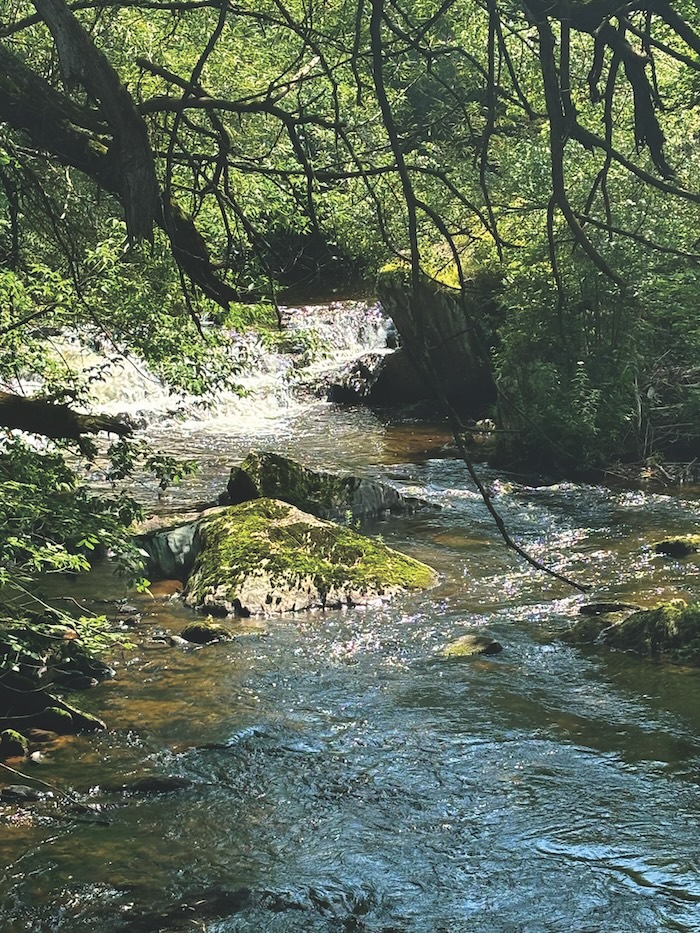
The first member of the Ware family to settle in the area was John, who in 1876 purchased several lots of land from Dr. Thomas Prime on the North Branch of the Yamaska River near the present-day bridge on Ware Hill at the intersection of Valley Road. John was the son of Lemuel Pratt Ware and Laura Fessenden, who resided at what is now the intersection of Mt. Echo Road and Sugar Hill. Lemuel’s sister Mary and her husband Luke Knowlton also lived at this location. The Ware siblings had roots in the area near Ware Hill, as their mother was a Pratt, a family that was among the earliest residents of Brome Village. Laura was a great aunt to Reginald Fessenden of West Bolton, who was famous for making the first radio voice transmission in 1906, and in 1922 achieving the first radio-telegraphic voice radio communication across the Atlantic Ocean.
John Ware, known locally as Jack, began farming the land on Ware Hill with two oxen and had little else, unable to afford a bed so he slept on the floor on straw. Soon after, John married Mary Louisa Smith, a schoolteacher, who had some savings that allowed them to purchase a cow. The farming operation slowly developed.
A decade prior, David Wood Smith and Sarah Jenne moved to the area from Dunham Township and purchased a saw and grist mill on the North Branch of the Yamaska River near Ware Hill from Walter Wood. (While it seems likely that Mary Louisa was closely related to David W.Smith, this cannot be confirmed in archival records.) The Smiths built the house and barns near the corner of Ware Hill and Valley Road. They began raising colts, the income from which allowed them to build a large barn. The Wares eventually came to own much of the land around Ware Hill. Their son Anson Ware and his wife Grace Tilton continued to live on the original farm into the 1960s.
By 1871, David W. Smith’s son Cornelius had built a new two- storey mill on North Branch at Ware Hill, grinding grain on the lower level. Upstairs was a woodworking shop engaged primarily in the manufacture of windows and doors. Cornelius is listed on the 1869 Brome property-assessment role as a (window) sash maker.

In 1875, Cornelius converted the woodworking shop to a factory manufacturing pipe organs. A warehouse also was built. He recruited skilled craftsman from New England, including an experienced organ-maker from Boston, who supervised operations. An article in the Waterloo Advertiser in June 1875 described the Smith organs as “instruments for which tone and finish are pronounced by experienced musicians [of] the very best material and workmanship [and] equal to the very best American organs.”
The organs produced at Ware Hill quickly gained a worldwide reputation for very high quality, winning an award in Australia (following the shipment of 30 organs to that country) and becoming well known in the United States. However, within a few years the operation’s success was thwarted by a global recession, and production ceased abruptly at the end of 1878. Smith organs, or course, continued to be played. The Lac-Brome Museum has a Smith Organ made at the Ware Hill factory in playing condition, although it is not currently on display. The museum also owns a Smith Piano Case Melodeon.
The Ware Hill facility reverted to the profitable window-and-door business. The buildings remained on the site until 1925, when they were taken down by the business’s then-owner, Harry Wallace. (Wallace had relocated the business to Waterloo around the turn of the century.) The former mill/factory was demolished, but a showroom building was moved to Brome Village and began a new life as a gas station. Today, nothing remains on the site, not even the remnants of a dam.
‘Places of Brome County’ is a continuing feature in Tempo, written in conjunction with Anne-Marie Charuest of the Lac-Brome Museum Archives, telling the stories behind historic locations in Brome County. Coincidently, the museum is presenting an exhibition until April 12, 2025, ‘From A to Z: The Path of Brome County’s Family Origins’,
on the stories behind selected street and road names in the area.
You must be logged in to post a comment.